In 2004, Simon & Schuster published Genius Denied,
co-authored by Jan and Bob Davidson with Laura Vanderkam
|
|
|
|
Q. Why is an IQ score needed for a gifted child? I'm not sure I want a number attached to my daughter's ability. - K.J. A.
An IQ score is one indication of whether your daughter’s educational needs will be met by the standard curriculum or whether a different kind of educational program will be required to meet her needs.
Gifted students are extraordinary learners with exceptional
needs. It is important to know just how exceptional these
students are in order to determine appropriate educational accommodations. A gifted student with an IQ of 140, for example, will require a significantly more advanced educational program than a student with an IQ of 125. To understand more about the different ranges of high ability learners and their educational needs, see IQ and Educational Needs. |
|
|
Q. What is the best type of schooling for a student with a high IQ? - L.N. A. It depends on the student. Like other exceptional students, they should have an Individualized Educational Program (IEP) that is optimally matched to their abilities. We have found the two most important characteristics of any schooling situation are flexibility and open-mindedness. Highly gifted students need a learning environment that supports them socially and emotionally, as well as intellectually. These students also should have an opportunity to learn with their intellectual peers. For suggestions on schooling options, see Twelve Cost Effective Educational Options. | |
|
Q.
Is there any evidence that highly
exceptional students really benefit from their advanced
abilities? Some claim that high test scores are irrelevant because other factors, such as motivation or curiosity, play a more important role than
testing.
A.
A recent 20-year longitudinal
study from Vanderbilt University provides evidence that
higher IQ scores are correlated to significant contributions
as an adult.
Researchers Jonathan Wai, David Lubinski and Camilla Benbow
studied the careers of over one thousand 33-year-olds who scored in the
top 1% on the SAT at the age of 13. The researchers found that
those who scored in the top quartile of the top 1% excelled
significantly more than those in the lower quartile of the top 1%
by earning advanced degrees, higher salaries, more patents
and achieving tenure at top U.S. universities. | |
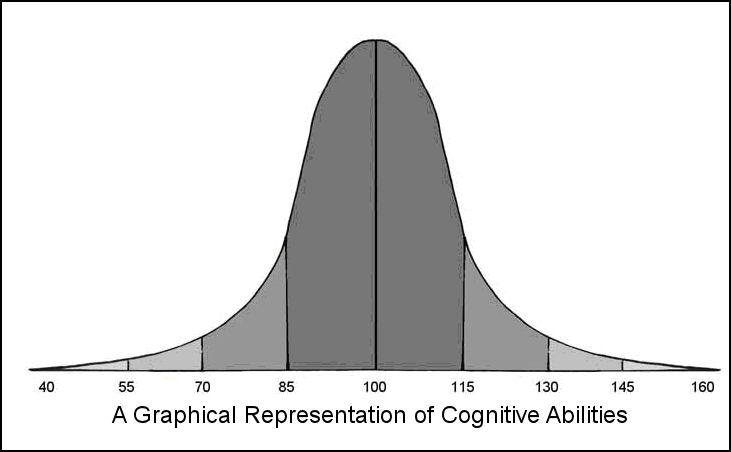
| Commentary: The Vision and the Reality In our effort to help profoundly intelligent students receive an appropriately challenging education, we have found a school’s vision is seldom the reality. Schools generally have a vision statement that includes words about educating students to “serve unique and diverse needs,” “maximize their potential,” “strive for excellence,” “promote excellence in learning,” “build a legacy of excellence,” etc. All too often the individual needs of highly gifted students are ignored. Sometimes schools that strive for excellence do little to assure achievement for their brightest students. In many instances, high ability students are placed in classrooms designed to teach to the mean, or students that fall within the average section of the bell curve. The high ability students who are left to fend for themselves learn little and become bored. Some get so frustrated that they even drop out of school. We have found that in many cases, advanced curriculum is not provided to an exceptionally bright student without the strong intervention of an outside advocate. Serving the individual needs of a diverse group of students based on ethnicity and/or socio-economic factors is a priority in most schools today. However, highly intelligent students are seldom considered a part of this “diversity,” regardless of how many non-Caucasian students are among the high achievers. It is painful to see any group discriminated against for any unfair reason - the color of their skin, their gender, or their innate ability.. Because the brightest students are ignored in many schools throughout the nation, we are requesting a call to action for all schools to remain true to their vision and serve the exceptional needs of gifted learners. | |
|
* * *
If you or your organization are interested in a book signing or
a "Meet the Author" session |
|
|
"Failing to meet the needs of bright students because of the hazards of defining giftedness is like failing to feed the hungry because people quibble over how many calories the body requires." - Genius Denied: How to stop wasting our brightest young minds |
|
|
The Davidson Institute
for Talent Development Stay UP-to-DATE with the LATEST NEWS in GIFTED EDUCATION 9665
Gateway Drive, Suite B, Reno, Nevada 89521 NOTE:
The appearance of selected programs and/or resources in the Davidson
Institute's Genius Denied Newsletter does not imply
an endorsement or affiliation. Programs and resources are
highlighted for informational purposes only. |
|
| Visit the Davidson Institute's Genius Denied Newsletter archive page at Davidson Gifted Database. | |
 Welcome back!